“I like your hat,” she said.
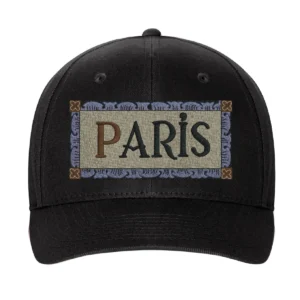
“Thanks,” I said. My black baseball cap sat on the bar, “PARIS” embroidered in a fancy script on it. I measured her look. “There’s a story,” I went on, watching for a telltale. Was she really interested or would I see that flicker of “Uh oh, what am I getting into?”
She did a quarter turn toward me on her stool, picked up her beer and nodded at me.
“I’m Paris,” I said, gesturing at the hat with a wry shrug. “Nice to meet you.” I smiled and glanced at her eyes.
“Nice name,” she said, glancing . “I’m Laura. So, were your born in Paris?”
I get that a lot. I wasn’t. I did have a French grandmother, Germaine, who was born in Lille. But the name was given to me by my parents who were struck by the tragic and romantic story of the love affair between Paris Singer, an heir of the Singer sewing machine wealth, and Isadora Duncan, the famous dancer. She died in a tragic accident which punctuated an even more tragic life. It’s a little bit much for a casual bar story, though, so I gave her the short version.
“My parents thought it was a romantic name.”
“It’s nice. I don’t think I’ve known a guy with that name.” She narrowed her eyes and turned her head to the right, “So what’s the ‘story‘?”
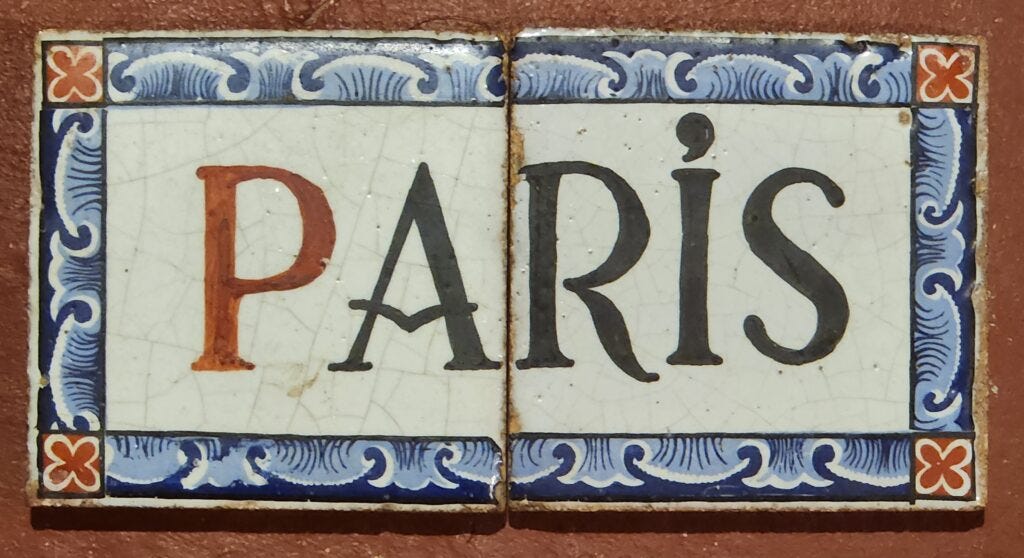
“Short version: My dad was in Paris years ago when they were modernizing the Metro. There was a pile of debris. He saw two discarded tiles: ‘PA’ and ‘RIS’ — that used to be part of the station wall. He grabbed them and brought them back for me. They are beautiful, so I thought I’d have a hat made.”
“Wow,” she said. “Great story, and lucky.”
“You’re right. It’s amazing they were intact and not smashed to bits, and that he was there at that exact moment.”
Notes for the rest of the piece:
If you know more about these tiles, please contact me and share what you know. If you are from a museum, I’d be very interested in getting them to your collection.
These are Nord-Sud Company tiles, specifically from the “Station-Type” frieze designed by Lucien Bechmann in 1910.
The “Nord-Sud” Signature: While the city-run CMP used simple white tiles, the private Nord-Sud line (now Lines 12 and 13) wanted to be the “Luxury” line. They used a specific visual language that my father rescued:
The Wave (The “Vague”): That blue and white wave pattern was the official border for all Nord-Sud stations. It’s actually a stylized “S” or “N” motif representing the “North-South” connection.
The Red “X”: These were decorative rosettes. In the 1910 design, the color of the frieze and the rosettes told the passengers what kind of station they were in.
Brown/Yellow: Standard stations.
Green: Transfer stations.
Blue/Red: Major hubs and terminal stations (like Gare de Paris-Saint-Lazare).
The Lettering: Even if they look black, they were often a very deep, midnight cobalt that darkened over decades of tunnel grime.
The “Grand Finale” Station: Since they spell “PARIS” and have the “Major Hub” blue/red frieze, your father likely found them at the entrance to Paris-Saint-Lazare. During the 1960s/70s, that station was “modernized” with aggressive orange and plastic panels, and the beautiful 1910 ceramic murals were literally hammered off the walls.